Pure Cycle is a closed-loop filter press water recycling system made for the stone and granite fabrication industry. Compare filtration, process-water supply and solids handling against your shop’s requirements.
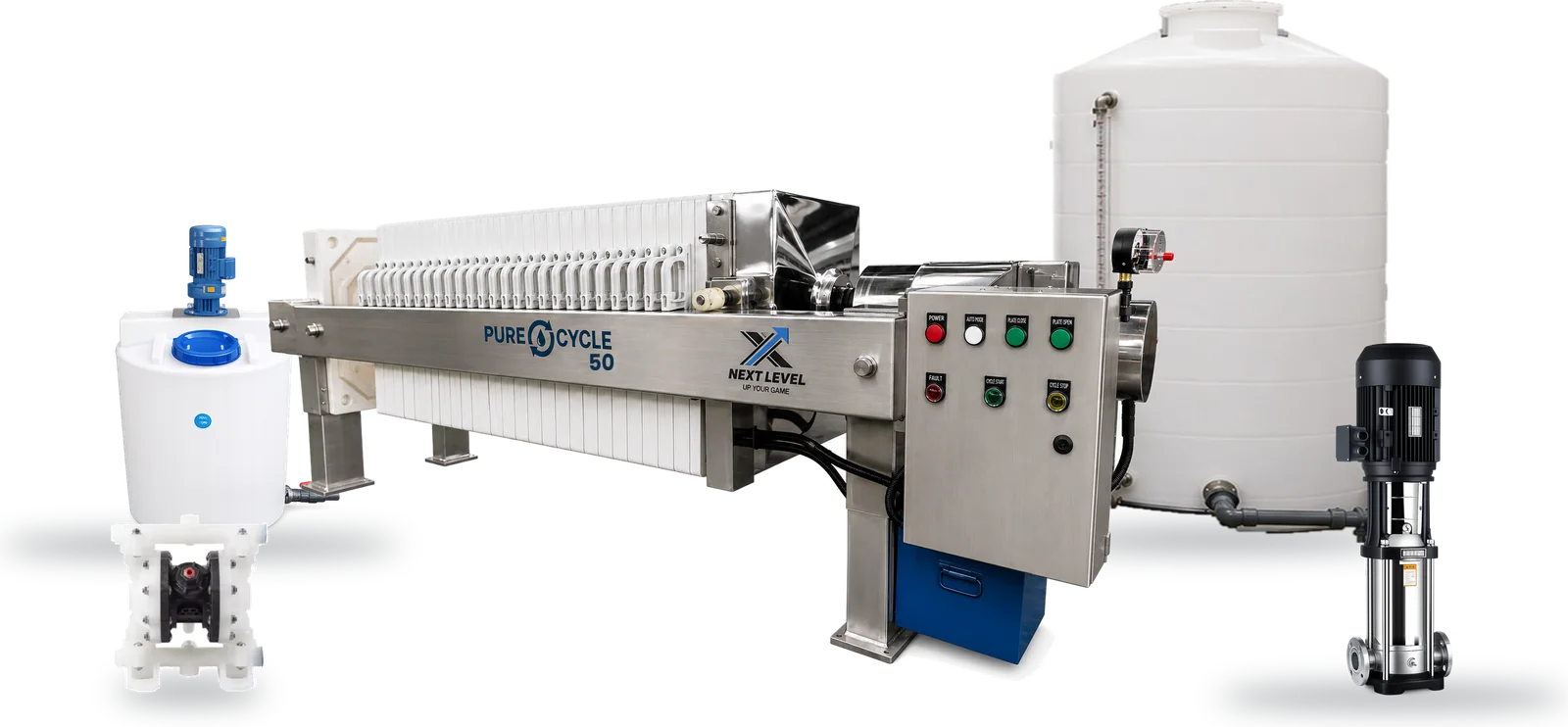
Pure Cycle 50: Complete system: press, flocculant tank and pump.
Press or clarification?
A stone water filter press separates solids from slurry and compresses them into cakes. A clarification system settles or separates suspended solids before water is returned to production. They can be parts of the same treatment circuit, rather than interchangeable machines. Ask how sludge leaves the system, how often the operator unloads it, and which water streams require additional filtration.
Size around the shop
List every machine that uses water, its required flow, inlet pressure and permitted particle size. Separate simultaneous demand from short peaks. Then record slurry production, operating hours, pit volume and the time available for cleaning. Nominal filtration flow is not a guarantee of continuous delivered flow under every slurry condition; ask for a sizing review using your material mix and cycle time.
PureCycle or Pure Cycle?
PureCycle 50 and Pure Cycle 50 refer here to the same Next Level model. Pure Cycle 50 uses a 30 m² chamber filter press, 2,000-gallon clean-water storage and a 5.4 HP return pump. Pure Cycle 100 uses a 50 m² press, 2,500-gallon storage and a 10 HP pump. The published nominal filtered-water figures are 52.8 and 105.7 GPM respectively. These are catalog figures, not a measured throughput promise for your shop.
Compare the complete circuit
Park Industries publishes HydroClear PRO 400 as a water recycling system with clarification features, automated dosing and a stated 325 GPM sustained flow. Water Treatment Solutions describes ECO-Clean as rapid settling and ENVIRO-Clear as filter-press based. Compare each proposed configuration on the same water-quality, sustained-flow and solids-handling requirements; the systems and quoted scopes are not automatically like-for-like. Do not infer a Pure Cycle flow advantage from filter area or tank capacity.
Before requesting a quote
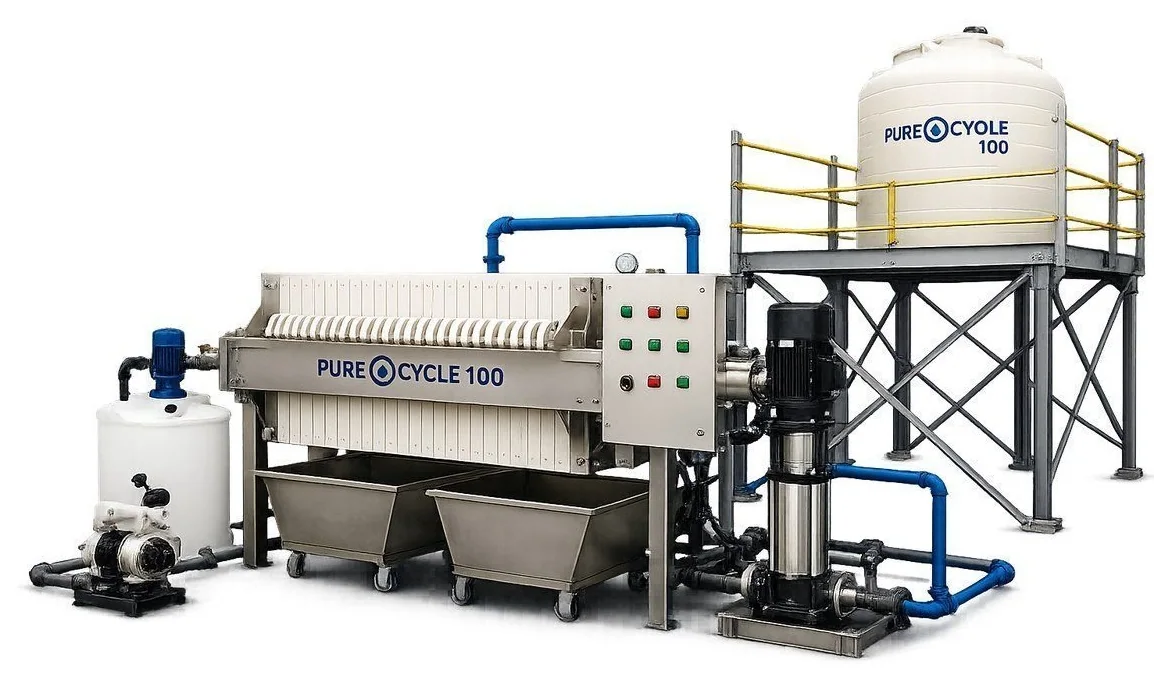
Confirm the pit and drain layout, pump duties, electrical service, indoor clearance, tank access and cake-removal route. Ask the supplier to list filter cloths, chemistry, maintenance intervals and consumables separately. Confirm whether tanks, platforms, piping, freight and site work are included. The Pure Cycle 100 elevated tank platform is optional; do not assume that equipment price covers your entire water installation. Recycled process water is not drinking water, and local discharge and waste rules still apply.
Water and dust support
The 5-Bag Sludge Dehydrator, wet dust collection wall and Trench Box are separate supporting products, not additional Pure Cycle filter-press models. Describe the waste stream, process and proposed installation when discussing these products. Dust capture and slurry treatment have different purposes; neither is a promise of regulatory compliance for the whole shop.
Compare the quote
Use the same requirements for every supplier. Download a blank worksheet, keep one copy per proposal, and record the written evidence behind each answer.
Simultaneous water demand. List each machine, flow, pressure and operating overlap. Request sustained delivered flow and usable storage separately.
Required water quality. Record each machine supplier’s water-quality limits and ask which treatment stage serves each circuit.
Slurry and cake removal. Request the press-cycle assumptions, cleaning procedure, chemistry and cloth requirements, and the complete route for removing solids.
Utilities and site work. Request the electrical, water, air, drainage, clearance and foundation requirements that apply to the quoted configuration. Identify who supplies each connection.
Complete quoted cost. Separate equipment, options, tooling, freight, tax, rigging, installation and training. Identify exclusions and the quote currency and validity.
Delivery and acceptance. Request the written delivery estimate, unloading responsibilities, commissioning scope and acceptance procedure.
Service and consumables. Request warranty terms, support coverage, consumable part numbers, maintenance intervals and quoted parts lead times.
Documented configuration. Keep the dated proposal, exact model and configuration, manuals and supplier answers together. Resolve conflicting specifications in writing.
Opens in spreadsheet software. Next Level does not receive the information you enter in your downloaded worksheet. This worksheet is not engineering approval or a purchase contract.
Pure Cycle 50 is the compact closed loop for smaller shops. A 30 m² (323 ft²) stainless chamber filter press squeezes the stone solids into cakes, a 2,000-gallon tank stores the filtered water, and a 5.4 HP pump sends it back to your machines.
Pure Cycle 100 turns your shop's slurry back into clean process water. A 50 m² (538 ft²) stainless chamber filter press squeezes the stone solids into cakes, a 2,500-gallon tank stores the filtered water, and a 10 HP pump sends it back to your saws, CNCs and polishers.
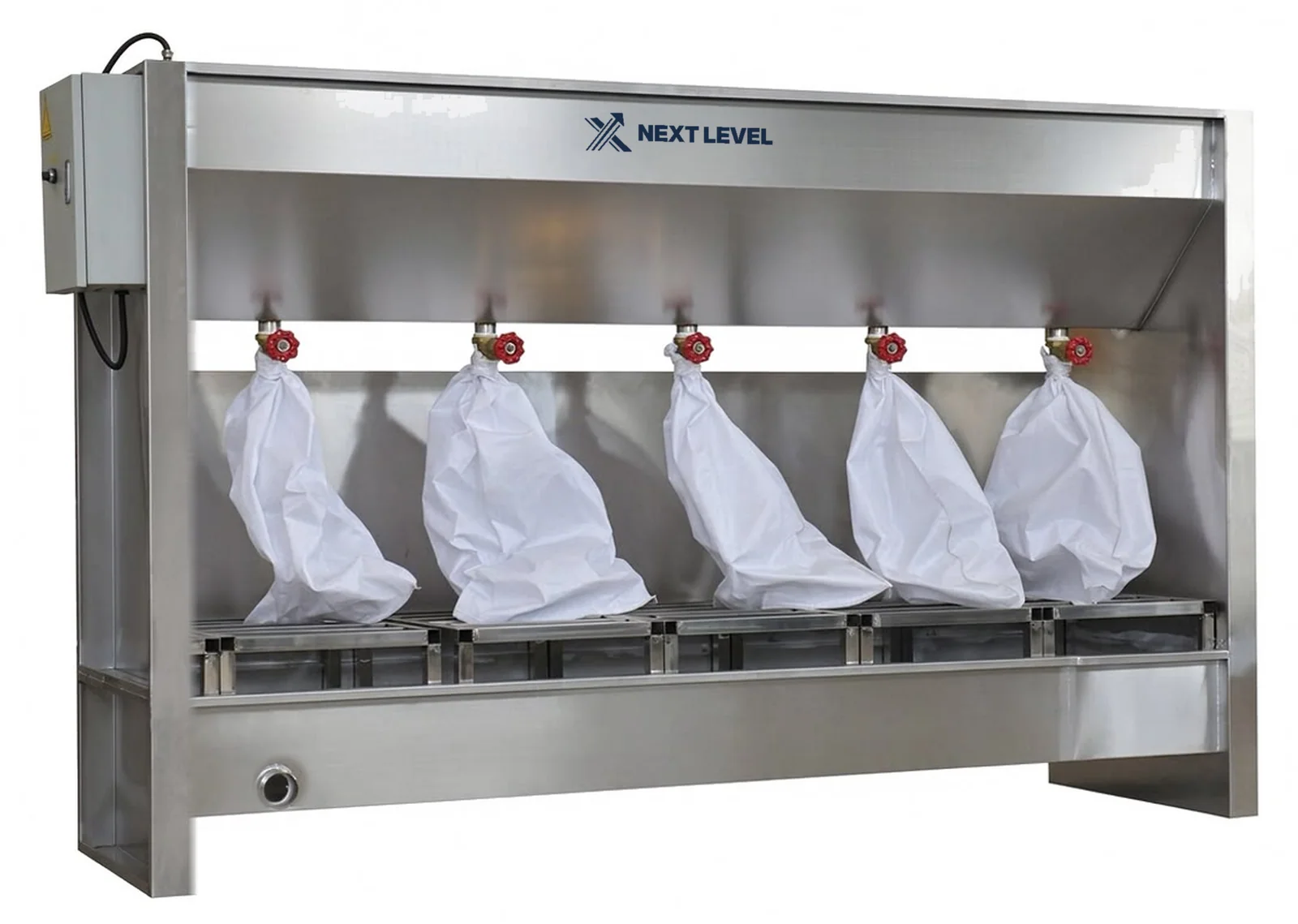
A stainless-steel station that pumps stone slurry into five filter bags. Water drains through the bag cloth to the tank; the solids stay in the bags, ready to lift out and dispose of.
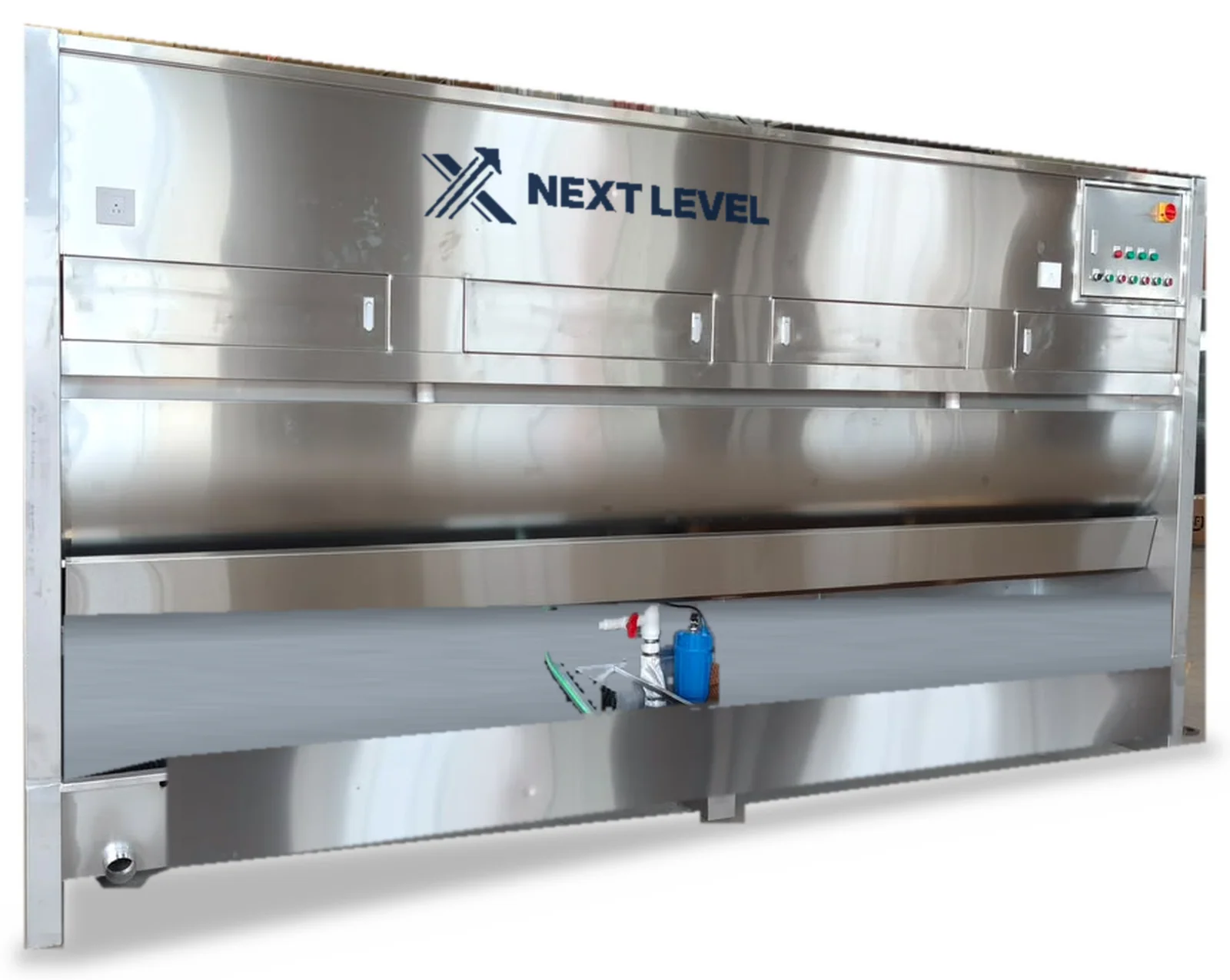
A 13 ft (4 m) stainless-steel water wall for hand work on stone. Three fans pull the dust into a curtain of water, the water carries it down to the tank and a submersible pump sends it back to the top.
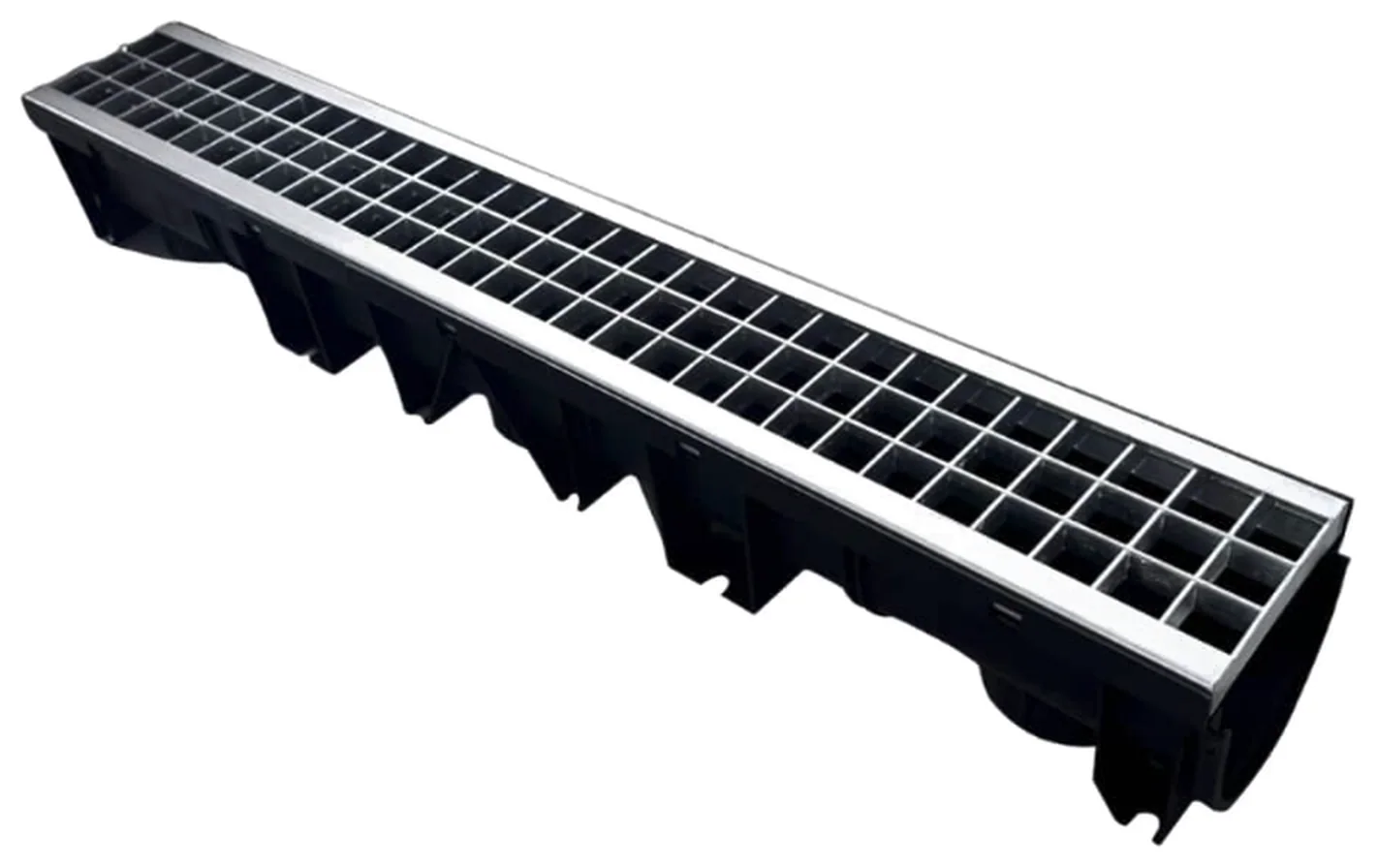
Three 1 m polymer channel sections with steel mesh grates make 3 m (9 ft 10 in) of trench that collects shop water and sends it to your drain, settling tank or water recycling system. The sections click together end to end and are set in concrete, with the grates finished flush with the floor.
ECO-Clean rapid-settling and ENVIRO-Clear filter-press system descriptions.
Buying questions
Does a larger tank mean more filtration?
No. Storage buffers demand; filtration and pump capacity determine how quickly suitable process water is supplied. Size those separately and confirm usable tank volume.
Can every machine use the same recycled water?
Not necessarily. Ask each machine supplier for its water-quality requirements, especially spindle and waterjet equipment, and have the treatment supplier specify the appropriate circuits.
How do I size water recycling for multiple stone machines?
List the flow, pressure and water-quality requirements of each machine, identify which run at the same time, and share the peak demand, operating hours and slurry characteristics with the system supplier. Check sustained supply and storage separately.
Is a filter press the same as a settling clarifier?
No. A filter press dewaters slurry into cakes; a clarifier separates suspended solids through settling or other separation. A complete shop circuit may use different stages, so compare the proposed equipment and solids handling rather than the labels alone.
Choosing a CNC for granite starts with the work you need to finish: straight cuts, miters, drilling, milling or waterjet inside corners. Axis count alone does not tell you which operations a machine can complete.
A 3-in-1 compressor combines a rotary screw compressor, air dryer and receiver tank in one package. For a fabrication shop, compare delivered airflow and air quality at the required pressure, not horsepower alone.
A forklift for granite slabs must be selected around the complete load, attachment and travel route. The model name or nominal capacity is not permission to lift every slab of that weight.
A vacuum lifter robot for granite must move and position the slab safely at the actual reach you need. Compare a self-propelled robot with another robot, not just with a below-hook suction frame.
Machining a finished edge and cutting an inside corner are different jobs. Choose the cutting process and tooling before comparing spindle power or axis count.
Start with the surface you need to finish: a slab face, a straight edge or a particular profile. Different polishing machines are designed for different work.
A site template records where the countertop must fit. A slab scan records the material you will cut. Connecting both correctly is the important workflow.
Plan the path from receiving to storage, fabrication and dispatch. Select each rack, cart, table and attachment for the actual load and the approved handling method.
Choose crane coverage around the pickup and placement locations. A lifting capacity alone does not define the reach, structure or complete installed system.